Nigeria’s oil and gas industry is, by every measure, a pillar of the national economy. Oil sales account for about 90% of total exports and between 60% and 85% of government budget revenues. The country also holds more than 37 billion barrels of proven crude oil reserves, the largest in Africa, alongside natural gas reserves estimated at over 6 trillion cubic metres.
These are not just impressive figures. They represent the fiscal foundation on which schools are built, infrastructure is funded, and Nigeria’s ambitions at home and abroad are financed.
Yet for all this endowment, the industry has consistently underperformed relative to its potential. Production inefficiencies, chronic skills shortages, costly and dangerous training environments, ageing infrastructure, and years of technological inertia have all limited how much value Nigeria can extract from its oil and gas wealth.
The sector knows change is necessary. The real question has always been how that change should happen, and what tools can help accelerate it.
That question matters even more now, as capital begins to flow back into Nigeria’s upstream space. NNPCL is targeting three million barrels per day by 2030. Shell is advancing the Bonga North deepwater project. TotalEnergies has committed $550 million to the Ubeta gas field. ExxonMobil has announced a $1.5 billion investment in the Usan deepwater oilfield.
The signals are unmistakable. But capital alone does not build a world-class oil and gas industry. People do, and so do the systems that prepare, train, and equip them.
One answer, increasingly validated by data and adopted by leading energy companies around the world, is Virtual Reality.
Why Nigeria’s Oil and Gas Industry Needs a New Learning Model

The Nigerian oil and gas sector has long depended on a mixture of classroom instruction, site exposure, and apprenticeship-style knowledge transfer. That model served its purpose in a less complex operational era. Today, it is increasingly insufficient.
Deepwater production, asset integrity management, emergency response, process safety, and digital operations all demand faster, safer, and more repeatable learning systems than conventional training can provide.
The problem is not the people. Nigeria has no shortage of talented, motivated professionals. The problem is the infrastructure for building and sustaining the kind of deep operational competence that the sector’s next chapter demands.
NCDMB’s recent human capital agenda reflects the urgency. In 2025, the Board launched field-readiness and digitalisation initiatives aimed at preparing over 10,000 Nigerians for high-demand technical roles, covering petroleum engineering, process operations, geoscience, and data analytics.
The instinct is exactly right. But the quality of preparation, not just the quantity of people trained, will determine whether that investment translates into operational performance.
That matters because the future workforce will need more than technical awareness. It will need digital fluency, scenario-based judgement, and the kind of operational confidence that only comes from repeated, realistic practice. Virtual Reality is built precisely for all three.
What Virtual Reality Actually Brings to Industrial Operations
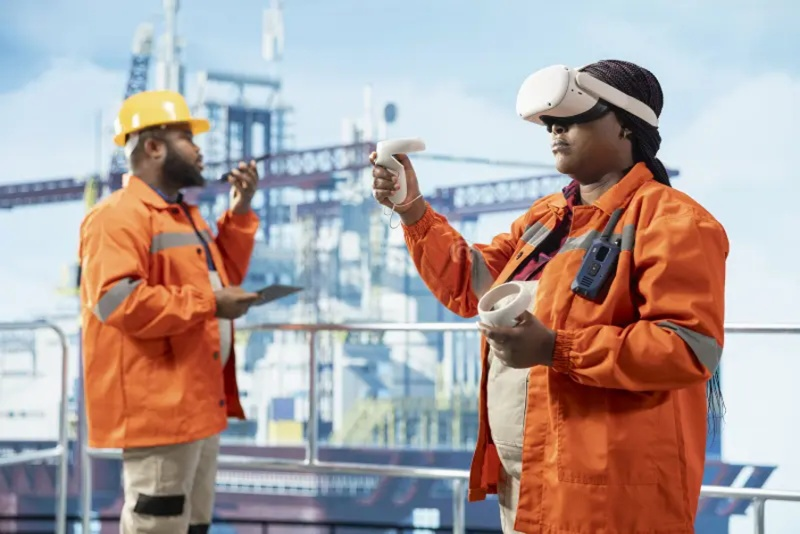
Virtual Reality is not simply “3D training.” In an industrial setting, it creates a simulated environment where workers can interact with equipment, procedures, alarms, hazards, and decision points as though they are on a live site.
The key advantage is that the trainee experiences consequences without exposure to real-world danger. That makes VR especially valuable in oil and gas, where many critical incidents cannot be safely rehearsed on active assets.
A worker can stand on a virtual offshore platform, hear the alarm, feel the pressure of a high-stakes decision, execute an emergency shutdown, and debrief on what went wrong, all without ever leaving a training facility. The simulation responds in real time, and the learning sticks.
Leading operators have already moved well beyond the pilot stage. Shell, ExxonMobil, BP, and Chevron have each integrated VR into their training and operational workflows, using immersive simulations to introduce personnel to new facilities, rehearse complex procedures, and build competence at scale.
The strongest industrial use cases fall into four broad categories. The first is training, particularly for safety-critical roles where the cost of errors, human or financial, is severe. The second is operations planning, where teams rehearse complex procedures before execution, reducing the risk of costly mistakes in live environments.
The third is remote collaboration, where technical experts can support field teams from a distance without the expense and delays of physical travel. The fourth is asset visualisation, particularly when VR is layered onto digital twin systems to create a living, interactive model of physical infrastructure.
Together, these capabilities transform VR from a learning tool into a full operational capability. This is particularly relevant in a sector where mistakes are expensive, downtime is costly, and the margin for error is vanishingly small.
How VR Can Transform Workforce Development
One of the most immediate applications of VR in Nigeria’s oil and gas industry is workforce development.
The sector faces a growing skills gap, especially as indigenous operators take on more complex assets and responsibilities. NCDMB’s efforts to train over 10,000 Nigerians in high-demand oil and gas skills show just how urgent the challenge has become.
VR can help solve this in several ways:
1. Faster learning without sacrificing quality
PwC’s research found that VR learners complete training four times faster than classroom learners and feel 275% more confident applying what they have learned on the job. A workforce development programme that might take 12 months in a conventional setting can produce equivalent or superior competence in a fraction of that time. For Organizations racing to staff up for a new era of upstream investment, that acceleration is a genuine competitive advantage.
2. Dramatically better knowledge retention
Because VR is experiential rather than passive, it produces knowledge that stays. Studies show that VR training delivers retention rates of up to 80% a year after training, compared to roughly 5% for lectures and 20% for audio-visual instruction. Instead of reading a procedure in a manual, the worker lives through it in simulation, building procedural memory that survives the gap between training and deployment. In a sector where lapses of memory under pressure can have severe consequences, that difference is not trivial.
3. Standardised training quality across dispersed operations
Oil and gas operations in Nigeria are geographically spread across offshore assets, onshore facilities, and remote sites, each with its own operational context but all requiring the same standard of competence. VR makes it possible to deliver identical, rigorously designed training content across every location. A technician in Port Harcourt and a platform worker 70 miles offshore can both train on the same virtual simulation, to the same standard, with the same scenario fidelity.
4. Safe practice of high-consequence procedures
Certain critical tasks, such as emergency shutdowns, blowout response, and confined space rescue, simply cannot be practised on live equipment without creating unacceptable risk. VR removes that constraint entirely. Workers can rehearse the full sequence of a well control event, repeat it until they have it right, debrief on their performance data, and then do it again. The environment mirrors the real one precisely; the consequences of errors do not.
5. Scalable onboarding for a generation of new entrants
Nigeria’s oil and gas sector is about to absorb a significant cohort of young professionals through NCDMB’s field-readiness programme and the broader expansion of local content. VR enables Organizations to onboard these individuals efficiently, building foundational competence at scale without the logistical expense of repeated site visits or live equipment shutdowns for training purposes.
6. Measurable competency tracking and compliance documentation
Enterprise VR platforms today generate granular performance data, such as the decisions the trainee made, how quickly they responded, and where they made errors, that can be exported directly into Learning Management Systems and HSE compliance frameworks. For Organizations operating under NCDMB local content requirements and international safety standards, the ability to produce auditable competency records is not a nice-to-have. It is an operational necessity.
Why VR Is a Game-Changer for HSE and Emergency Response

If there is one area where VR makes the strongest and most urgent business case in Nigeria’s oil and gas sector, it is health, safety, and environmental management.
Oil and gas is a high-hazard industry by its nature.
In Nigeria’s specific operating environment, that hazard is compounded by the unique complexities of offshore exposure, infrastructure vulnerability, community relations in the Niger Delta, and the operational demands of ageing onshore assets being managed by a workforce in transition.
In 2024, NUPRC recorded 732 environmental incidents, a figure that underscores not merely the regulatory exposure but the human and reputational cost of inadequate preparedness.
The fundamental problem with traditional HSE training is the gap between what it simulates and what workers actually encounter. A classroom session on emergency response is valuable. A printed manual on gas leak protocols is necessary. But neither replicates the visceral, disorienting pressure of a real incident unfolding on a live platform.
VR allows teams to rehearse emergencies in a realistic but controlled environment. Workers can practise gas leak response, fire outbreaks, emergency shutdowns, evacuation procedures, confined space scenarios, and equipment failure sequences in a realistic but completely controlled environment.
The data on outcomes is even more compelling. Organisations using enterprise VR for safety training have reported up to a 30% reduction in procedural errors and measurable decreases in incident-related costs. Research shows a 25% to 30% increase in hazard recognition following VR training, which is arguably the most important leading indicator of safety performance.
What Nigeria’s Oil and Gas Leaders Should Do Next
The most important strategic question is no longer whether VR belongs in Nigeria’s oil and gas sector. The evidence has resolved that in the affirmative, and the world’s leading operators have moved on to implementation.
The real question for Nigerian leaders is where to begin, how fast to move, and what to prioritise. A few principles should guide that decision:
1. Start with pain, not possibility. Identify the specific operational challenge that is costing the Organization most, whether that is HSE incident rates, the time it takes to certify new technicians, the expense of offshore specialist visits, or the quality of emergency response. When VR is deployed against a real, documented pain point, the ROI becomes visible quickly, and the internal case for expansion writes itself.
2. Pilot with rigour. Define the competency metrics before deployment. Measure knowledge retention, hazard recognition, procedural accuracy, and incident rates before and after. Track the cost per trained worker and compare it to the conventional baseline. When the results come in, and they will, they become the foundation for a board-level investment decision.
3. Build for the Nigerian context. The value of VR in this sector depends significantly on how well the simulations reflect actual operating environments. A fire response simulation set in a generic refinery is useful. The same simulation set in a specific Nigerian facility, with the equipment configurations, layouts, and alarm systems that workers will actually encounter, is far more powerful. The investment in contextualisation grows in value as the content library expands.
4. Think beyond training. The operators who will extract the most value from VR are those who move beyond the training use case into operations support, digital twin integration, and remote collaboration. Training is the fastest way to demonstrate value and build Organizational confidence. But the strategic prize lies in the operational applications. Plan for both from the beginning, even if the execution is sequential.
NCDMB’s training agenda signals that the industry already understands the need to close skill gaps and prepare a new generation for a more digital future. VR gives companies a practical, evidence-based way to accelerate that transition, not as a replacement for the foundational programmes already underway, but as a powerful complement that makes them more effective.
The companies that move intelligently and early on this will not merely train better. They will operate better, compete better, and be better positioned to attract the capital and talent that Nigeria’s oil and gas sector needs to fulfil its considerable potential.